Thursday, July 15, 2010

Marvelous Messes!

The MHC After 3 group from the Virginia Museum of Natural History just finished up their week of the "Marvelous Messes" camp. Each day we did several experiments that involved getting messy and/or wet.

On the first day, the most favorite activities were definitely the baking soda/vinegar ones. When you combine baking soda (Sodium bicarbonate) and vinegar (acetic acid), a chemical reaction occurs that results in water, sodium acetate, and carbon dioxide. In our first experiment, that carbon dioxide blew up a balloon.


Then we used the reaction to create a cork rocket, which caused a lot of excitement! Everyone wore their safety goggles, just in case. Be sure to check out the video of our rockets!

Preparing the rocket

The cork rocket explodes (a little earlier than expected)!

And again!

On Day 2, we went out to Frank Wilson Park for some outdoor activities. First the group dissected owl pellets.


Then, everyone created a simulation of the ocean with an oil spill. Each group attempted to clean the oil out of the water with various materials. We also learned all about the current oil crisis in the Gulf of Mexico.


On Wedesday the group headed out to the Smith River to look for macro invertebrates and crayfish.

Using a kick net to find macros.

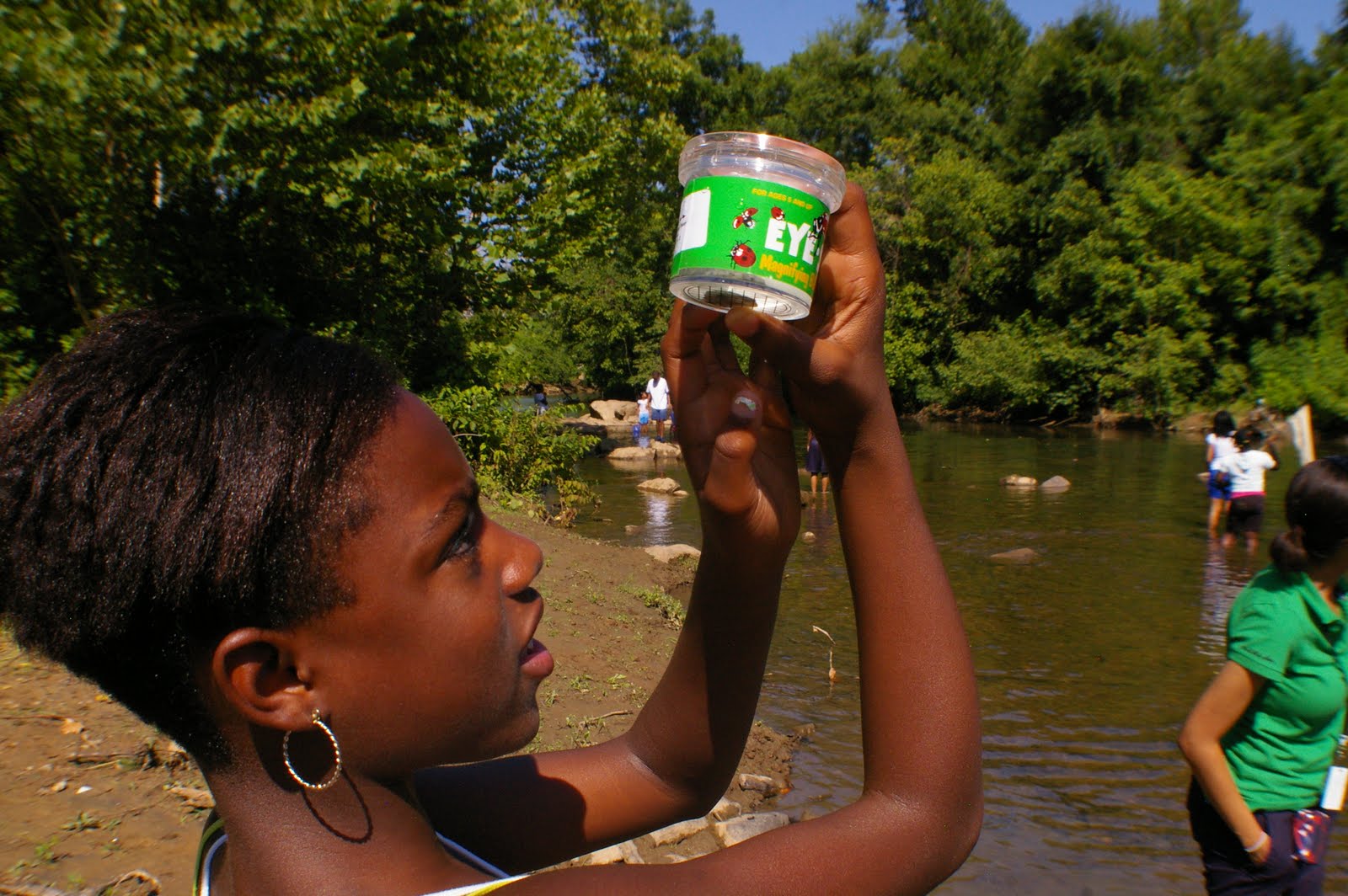
Ariel gets a better look at a small crayfish


Water quality testing


Finally, on the last day, the students learned how to extract DNA from fruit. They also built boats out of cardboard and duct tape, and then tested them to see if they were "sea worthy". The most successful boat held 130 marbles before it sank.

Extracting DNA from strawberries, oranges, and tomatoes. 

Monday, July 12, 2010

Friday at Fairy Stone

On Friday, the Martinsville YMCA group headed to Fairy Stone. We used a seining net in the lake to see what we could find. We found a few bluegills, a froglet, and several other small fish. Park Ranger Sam Jensen showed some of the kids how to use a casting net to catch fish.


Seining in Lake Fairy Stone


Then we went canoeing on the lake out to the dam. Only one boat tipped over, and everyone had a great time paddling!


Thursday, July 8, 2010

In the River!

Today, when the Martinsville YMCA group arrived at the Smith River, the fog was hanging in the air over the water. The morning was cool (and the water very cold) at the start of a day that was predicted to be a scorcher! The group learned about how the animals living in our rivers and streams can tell us whether they are healthy or not. Benthic macroinvertebrates can be found on the rocks in the river, and the number and kind you find indicate water quality. Brian Williams joined us, and showed everyone how to collect the macros, so we could identify and observe them. The water was a cold 54 degrees (we measured the temperature), but everyone waded in to look for animals. We found quite a few, and about 12 healthy crayfish! I think everyone had a great time in the river.

Fog over the Smith River

Two macroinvertebrates on a rock

Holding a black rat snake we found by the river

Brian Williams describes how he collects macroinvertebrates to determine the health of the river.

Wading into the water

Lots of crayfish!

Looking for critters in the water

Ready to catch something!

Everyone got used to the cold water eventually!

Wednesday, July 7, 2010

Martinsville YMCA at Lake Philpott

On Tuesday, the Martinsville YMCA MHC After 3 group joined us at Philpott Park overlooking the lake. We went through a fish life obstacle course called "Hooks and Ladders" (from Project WILD Aquatic)- the kids played the roles of fish (striped bass), predators (osprey), fishermen, and a dam turbine. While jumping through ropes, gathering food tokens and fish eggs, and doing a long jump (over a pretend waterfall), the students learned about the life cycle of salmon and striped bass. The fish had to make it out to the ocean and back to the spawning ground.
Trying to make it through the turbine.

The surviving fish with their "eggs".


Playing a round of "Bat, Moth" before heading out to the dam.

Then, we met up with Ranger Danny Martin, who took us out to the Philpott Lake Dam, where we got an excellent view of the lake, river, and mountains. He explained how the dam produced electricity and the benefits of hydroelectric power.

Ranger Danny Martin explains how the dam works.

Looking off the river-side of the dam

Viewing Philpott Lake and the Blue Ridge Mountains

Tuesday, July 6, 2010

Summer is Here!

Today was the first day of MHC After 3 Summer Camp with VMNH programming!

The group from the Martinsville YMCA joined us at Fairy Stone State Park to learn all about water quality and the effects of pollution.


First we all introduced ourselves with a game called "Surf or Turf", in which everyone learned that about 71% of the earth's surface is covered in water, but only about 3% of it is freshwater. We also learned that several of the campers had some exciting stories involving water.

Playing "Surf or Turf"

Playing "Surf or Turf"

Then we did a "Water Quality Relay", and the students learned that any pollution that we put on our land can eventually end up in our streams due to run-off after rain. (This is an example of non-point source pollution.)

Water Quality Relay: Simulation of run-off after rainfall

Next, the students paired up and tested the water quality of the stream that runs through the picnic area. They tested pH (tells us how acidic or basic a solution is), dissolved oxygen, temperature, and turbidity (how clear/murky the water is).

Testing the pH of their water sample

Recording the data

Finally, we finished with a walk in the stream to look for underwater wildlife. We found fish, crayfish, and aquatic insects.

Trying to catch a crayfish

Surveying the scene

Angie shows off the crayfish

More exploring

There's a fish in this cup!

The catcher (and releaser) of the fish

Crayfish!

The Martinsville YMCA group, after a full morning of activities.